


The Different Types of Moose in North America: Identification & Habitat Guide

Updated: Aug 25
Moose are one of North America's most unmistakable animals — towering, powerful, and perfectly built for life in the boreal forest and beyond. Whether you've spotted one standing shoulder-deep in a remote lake or seen the massive paddle antlers of a mature bull up close, there's no mistaking the continent's largest member of the deer family.
At Munroe Lake Lodge, we're fortunate to sit in the heart of some of the best Canadian Moose country on the continent — but did you know there are several different types of Moose across North America, each with their own size, range, and personality?
In this post, we'll take a closer look at the main subspecies of Moose found across North America, how they differ, and where you can find them in the wild.
1) Alaska-Yukon Moose (Alces alces gigas)
Habitat: Alaska, Yukon, and the northwestern corner of British Columbia
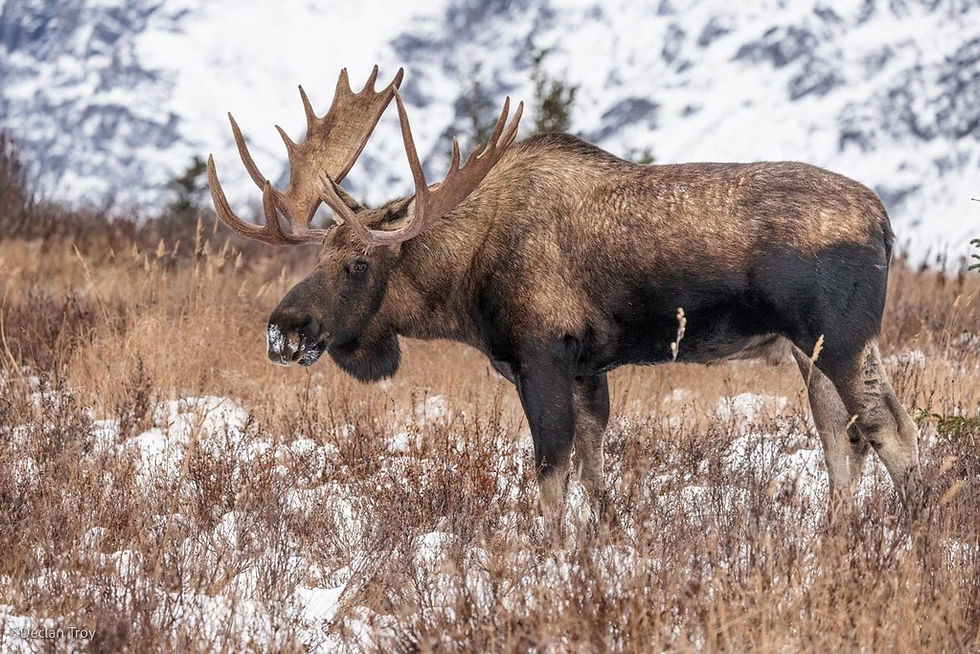
The Alaska-Yukon Moose is the largest subspecies of Moose in the world — and by extension, the largest member of the deer family on the planet. Mature bulls regularly tip the scales at 1,400 to 1,600 pounds, with some pushing past 1,800, and their antler spreads can exceed 70 inches from tip to tip. They thrive in the willow-choked river bottoms and sub-alpine country of the far north, where long summer days fuel explosive antler growth. If you're picturing a moose the size of a small car with paddles like serving trays, you're picturing this one.
2) Western Canadian Moose (Alces alces andersoni)
Habitat: Northern Manitoba, Saskatchewan, Alberta, British Columbia, the Northwest Territories, and parts of northern Ontario and the Dakotas
These are the Moose we know best at Munroe Lake Lodge. The Western Canadian Moose — often just called the Canadian Moose — is the classic boreal forest bull: massive-bodied, heavy-antlered, and built for the cold. Mature bulls commonly weigh 900 to 1,300 pounds, with antler spreads in the 50 to 60 inch range, and exceptional bulls pushing well beyond that. They roam our northern Manitoba wilderness feeding on willow, aspen, and aquatic plants, and during the rut they come charging to a well-timed cow call like nothing else in the woods.

3) Eastern Canadian Moose (Alces alces americana)
Habitat: Eastern Canada (Ontario, Quebec, Newfoundland, New Brunswick, Nova Scotia) and the northeastern United States (Maine, New Hampshire, Vermont, New York)
The Eastern Canadian Moose is the forest dweller of the east, at home in the mixed hardwood and spruce forests that stretch from the Great Lakes out to the Atlantic. They're slightly smaller than their Western Canadian cousins, with mature bulls typically weighing 800 to 1,200 pounds and carrying antlers in the 40 to 55 inch range. Newfoundland is a bit of a success story for this subspecies — just a handful of moose introduced in the early 1900s have grown into one of the densest moose populations on the continent.

4) Shiras Moose (Alces alces shirasi)
Habitat: The Rocky Mountain states — Wyoming, Montana, Idaho, Utah, Colorado — and parts of southern British Columbia and Alberta
The Shiras Moose, sometimes called the Wyoming Moose, is the smallest subspecies of Moose in North America — but don't let that fool you, a mature Shiras bull is still a truly massive animal. They typically weigh 600 to 1,000 pounds, with antler spreads averaging 35 to 45 inches. What they give up in size, they often make up for in antler character — Shiras bulls are known for dark, chocolate-coloured palms and dramatic fronts that make them a favourite among trophy hunters. They live in the willow flats, aspen groves, and high-country drainages of the American West.

Why Moose Matter
Moose are a symbol of the North American wilderness — a vital part of the boreal ecosystem and a cornerstone of our hunting heritage. At Munroe Lake Lodge, we're proud to share a landscape where Moose still roam the willow bottoms and cedar swamps as they have for generations, and where sustainable, well-managed hunting helps keep the herd healthy for the hunters who come after us.
Whether you're here to hunt, photograph, or simply share a quiet morning on the water with a bull feeding in the shallows, Northern Manitoba offers an unforgettable chance to experience these giants on their own terms.
Plan Your Adventure
If you're dreaming of seeing — or hunting — these incredible animals up close, our team would love to help you plan your trip. Visit our Moose Hunting page or Contact Us to book your next adventure at Munroe Lake Lodge.


Comments